

The Tree Things Blog
Volcano Mulching: A Missouri Sight, a Northwest Problem

Tree Things Blog · No. 19
Let me introduce you to the ball and burlap tree; "B&B" for short. A B&B is a live, field-grown tree that is dug up with its roots and a solid ball of native soil, then wrapped in burlap and tied up tight with twine or a wire basket.
How does a tree that size come out of the ground? A big machine called a tree spade scoops up the root ball in one piece. Sounds tidy, right? Not so much for the tree. Many of the smaller roots get left behind, and a large portion of the entire root system may be lost on the way out.
Watch out for the P-Trap Roots
Go look under your kitchen sink. See that pipe that goes down, then bends back up? That's a P-trap. Now picture a tree root doing the same thing inside the root ball: heading down, then bending back up.
Not all B&Bs are like this; it's just something to be mindful of. A healthy root ball has roots growing out and down (not up!) and enough soil to go around.
So what's the big deal?
Here is how a P-trap root turns into trouble:
Primary growth is up and down. Trees get taller.
Secondary growth makes a root get fatter.
Now comes the pinch. The root crown side gets fatter, the root side gets fatter, and the two squeeze each other. That's called impingement; I call it pinching. As the tree matures, it cannot get enough water or nutrients through that pinched root.
Trees don't grow like this in the woods
How a tree is grown in its first few years, and how it gets planted, affects its health and stability for the long haul. I have seen that many tree problems can be avoided by dealing with the P-trapped roots up front.
The goal of putting trees in the urban environment is to replicate what happens in the natural environment.
Well, I have never seen a wire cage and burlap wrapping a tree root ball in the woods.
I have also never seen roots that start at the bottom of a two-foot hole and grow up. Have you?
The debate rages
That burlap and wire cage are there for a reason: they hold the root ball together while the tree is moved to the planting site. But what happens to them once the tree is in the hole? That's where the debate rages.
Camp 1: Leave the wire cage and burlap on.
What they say
Folks in this camp say it helps the tree get established; the root ball is not disturbed, and whatever roots are left stay protected. It also keeps the soil structure around the roots. If the burlap is natural, they say, the fibers will decompose and the tree will grow around the wire cage.
Here's my trouble with that
Burlap gets in the way of roots growing out into the native soil. Bury it and it decomposes slower, so it stays a barrier much longer than anyone expects. The tree will conflict with the cage; it may grow around it, or it may get girdled. Leaving the burlap and wire cage on negatively affects the long-term health of the tree.
Camp 2: Cut the cage back and roll the burlap down, exposing at least the top third of the root ball.
Here's how:
Remove and discard any twine on the base of the tree and the basket.
Pull back the burlap and remove it from the top of the root ball.
Remove soil from the top of the root ball to find where the trunk starts to flare outward (find the chicken foot). If no flare is found, which is common on conifers, remove the soil down to the topmost root.
Remove the top one-third of the wire basket.
Pull back or remove the burlap in the top one-third of the basket.
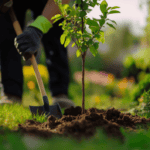
Backfill with soil, filling in all air pockets. Stake the tree if necessary.
Let's talk trees
So which camp are you in? Leave a comment and tell me how your trees went in the ground.
If you are around Spokane, Coeur d'Alene, or Post Falls and wondering what is going on below the soil line at your place, call me at 509.499.5308 or look around planthealthcs.com.
More to explore on the Tree Things Blog
There's plenty to dig into, from what your trees are worth to how to spot trouble before it starts.


2 Comments
The donut vs. volcano thing is going to stick with me. I walked out to my own yard after reading this and sure enough, one of mine is halfway to erupting. Pulling it back this weekend.
Keep pulling the mulch back until you can see the base of the trunk spread out into roots, like a chicken’s foot with the toes going out in different directions. If the trunk still looks like a straight pipe going into the ground, keep going. Easy fix, you got this.